


10000mAh vs 20000mAh Power Bank: Is the Extra Capacity Worth It?

A 10,000mAh power bank is a good fit for one phone and regular access to an outlet. A 20,000mAh power bank provides more reserve for repeated charging, shared use, or longer periods without an outlet. Balance the energy you need between charging opportunities against the weight you are prepared to carry.
Choosing between these capacities involves more than comparing the numbers on the label. Actual stored energy, carrying weight, and recharge time all affect how useful a power bank will be.
This 10,000mAh vs 20,000mAh power bank comparison looks at what the extra capacity buys you, how many phone charges to plan for, and when two smaller banks make more sense than one larger bank. If you are still choosing among several capacity sizes, start with our What Size Power Bank Do I Need?.
10,000mAh vs 20,000mAh: What Do You Gain—and Carry?
At the same nominal battery voltage, 20,000mAh stores twice the energy of 10,000mAh—but weight, thickness, and charging speed depend on the product. Check the actual specifications before assuming the larger bank is faster or much heavier.
What Does 10,000mAh Mean?
The label means 10,000 milliamp-hours of electrical charge capacity, normally specified at the nominal voltage of the internal battery. It is not a direct measure of how much charge will reach your phone battery, because voltage conversion and charging losses affect the energy delivered. To compare stored energy across different voltages, use watt-hours: Wh = (mAh ÷ 1,000) × nominal voltage.
For example, the VRURC 10,000mAh AC Plug Power Bank is listed at 38.5Wh, while the VRURC 20,000mAh AC Plug Power Bank is listed at 77Wh. That is a two-to-one energy comparison before charging losses. Here is how those same products compare physically:
| Specification | VRURC 10,000mAh AC Plug | VRURC 20,000mAh AC Plug |
|---|---|---|
| Listed stored energy | 38.5Wh | 77Wh |
| Listed weight | 227g | Approximately 368g |
| Dimensions | 151.2 × 70 × 18.2mm | 150.2 × 72 × 27.8mm |
| Built-in accessories | Charging cables and AC wall plug | Charging cables and AC wall plug |
In this pair, doubling capacity adds about 141g and 9.6mm of thickness. The footprint stays similar; the thicker shape is the more obvious change in a small bag. These are examples, not standard dimensions for every power bank. Sources: VRURC 10,000mAh AC Plug Power Bank and VRURC 20,000mAh AC Plug Power Bank.
Stored Energy Comparison (Wh)
Bar lengths use the same scale: 77Wh is twice 38.5Wh. These are energy amounts, not remaining battery percentages.
How Many Phone Charges Can Each Power Bank Provide?
Assuming 70–80% of stored energy reaches a 5,000mAh phone battery rated at 3.85V, the calculation gives about 1.4–1.6 full-charge equivalents from 38.5Wh and 2.8–3.2 from 77Wh. Phone batteries with lower Wh ratings need less energy for a full refill; those with higher Wh ratings need more.
To work out how many charges a 10,000mAh power bank can provide, check the phone's battery energy as well as the bank's capacity. The calculation is: full-charge equivalents ≈ bank Wh × assumed energy-transfer efficiency ÷ phone battery Wh.
| Phone battery assumption | 38.5Wh bank (10,000mAh example) | 77Wh bank (20,000mAh example) |
|---|---|---|
| 4,000mAh at 3.85V = 15.4Wh | About 1.8–2.0 charges | About 3.5–4.0 charges |
| 5,000mAh at 3.85V = 19.25Wh | About 1.4–1.6 charges | About 2.8–3.2 charges |
Calculation conditions: These estimates assume 70–80% of the bank's stored energy reaches the phone battery. That is an illustrative allowance, not a tested efficiency rating. Use the actual Wh labels for your devices. Navigation, video, temperature, battery condition, and charging method can change the result.
A full-charge equivalent is an energy estimate, not a count of completed charging sessions. As a rough planning example, three top-ups from 30% to 80% replace about 1.5 batteries’ worth of charge. Battery percentage is not a precise energy measurement, and using the phone while connected consumes additional power.
When Is a 20,000mAh Power Bank Worth It or Overkill?
A 20,000mAh bank is useful when your expected charging demand exceeds what a 10,000mAh bank can comfortably provide. For occasional small top-ups with reliable daily recharging, much of that extra reserve may go unused.
Is a 10,000mAh Power Bank Good for Everyday Use?
Yes. A 10,000mAh power bank is a practical everyday option for moderate phone top-ups. If you usually need to replace 30–50 percentage points before reaching an outlet, the 5,000mAh-phone example above leaves room for more than one outing's top-up. A larger capacity is worthwhile only if the additional reserve is useful to you.
The 20,000mAh option becomes easier to justify when your phone is also your map, camera, and hotspot, when a companion regularly borrows power, or when tomorrow's outlet access is uncertain.
- Choose 10,000mAh for one phone, modest top-ups, and reliable nightly recharging.
- Consider 20,000mAh for repeated heavy use, shared charging, or longer gaps between outlets.
- Prioritize carrying comfort if you often leave a heavier charger at home. A power bank should be comfortable enough to carry regularly.
Review how much battery you typically need to replace before reaching an outlet. This provides a better basis for choosing capacity than trip length alone.
Is One 20,000mAh Power Bank Better Than Two 10,000mAh Power Banks?
One 20,000mAh bank is simpler to manage; two 10,000mAh banks are more flexible when people split up or your needs change from day to day. Two 10,000mAh banks and one 20,000mAh bank have the same combined nominal charge capacity. Their rated energy is equal only at the same nominal voltage, and their usable output energy, weight, and cost can still differ.
Two smaller banks let each person carry a separate power source. That can be useful when you split up during a trip, rather than staying together to share one charger.
| Consideration | One 20,000mAh bank | Two 10,000mAh banks |
|---|---|---|
| Sharing | Convenient while you stay together | Each person can carry their own |
| Shorter outings | You carry the whole bank | Take one and leave one at home |
| Backup if one fails | No second bank available | A separately stored second bank remains an option |
| Refilling | One device to recharge | Two devices; parallel charging needs suitable power sources |
| Weight and price | Check the exact product | Add both products before comparing |
For the VRURC AC plug products above, two 10,000mAh banks weigh 454g in total, compared with approximately 368g for one 20,000mAh bank. The single larger bank saves about 86g before any extra accessories. This weight advantage applies to this product pair; other combinations may differ.
You can also leave one bank charging while you take the other with you, where that is practical. If your reason for packing two is backup, store them separately and make sure each has a working connection for your phone.
How Long Does a 10,000mAh or 20,000mAh Power Bank Take to Recharge?
Capacity alone will not tell you how long a refill takes. At the same average input power and similar efficiency, a battery with more stored energy takes longer to recharge from empty. A 20,000mAh bank with faster input charging, however, may refill sooner than a slower-charging 10,000mAh bank.
Check the input specification—the power the bank can accept. The output wattage describes the power available to connected devices; it does not specify how quickly the bank itself recharges. These two VRURC products show why the charging method matters:
VRURC 10,000mAhBuilt-in Cables & AC Plug
VRURC 20,000mAhBuilt-in Cables & AC Plug
Manufacturer estimates for the specific products linked above, using their listed input conditions. These are not results from a same-adapter test. The 10,000mAh product’s AC estimate specifically uses 220V; refill time may differ at other supported mains voltages.
Getting the Expected Recharge Speed
- Check the label or manual. Find the USB-C input voltage and current supported by your bank.
- Use a matching adapter and cable. The adapter must support the required charging profile; a higher wattage printed on the adapter does not guarantee faster charging.
- Confirm that charging starts. Check the battery display. If charging does not start or is much slower than the manual indicates, check the connection and try another compatible cable and adapter. Slower charging near full can be normal.
If you need the bank ready by morning, check the refill time for the method you actually plan to use. Our guide, How Long Does It Take to Charge a Power Bank, explains what affects that time.
Which Power Bank Fits Your Setup?
Choose the 10,000mAh option for lighter daily backup, or the 20,000mAh option when you will use the extra reserve. Both examples below include charging cables and a wall plug, so compare the exact connectors and input method alongside capacity.
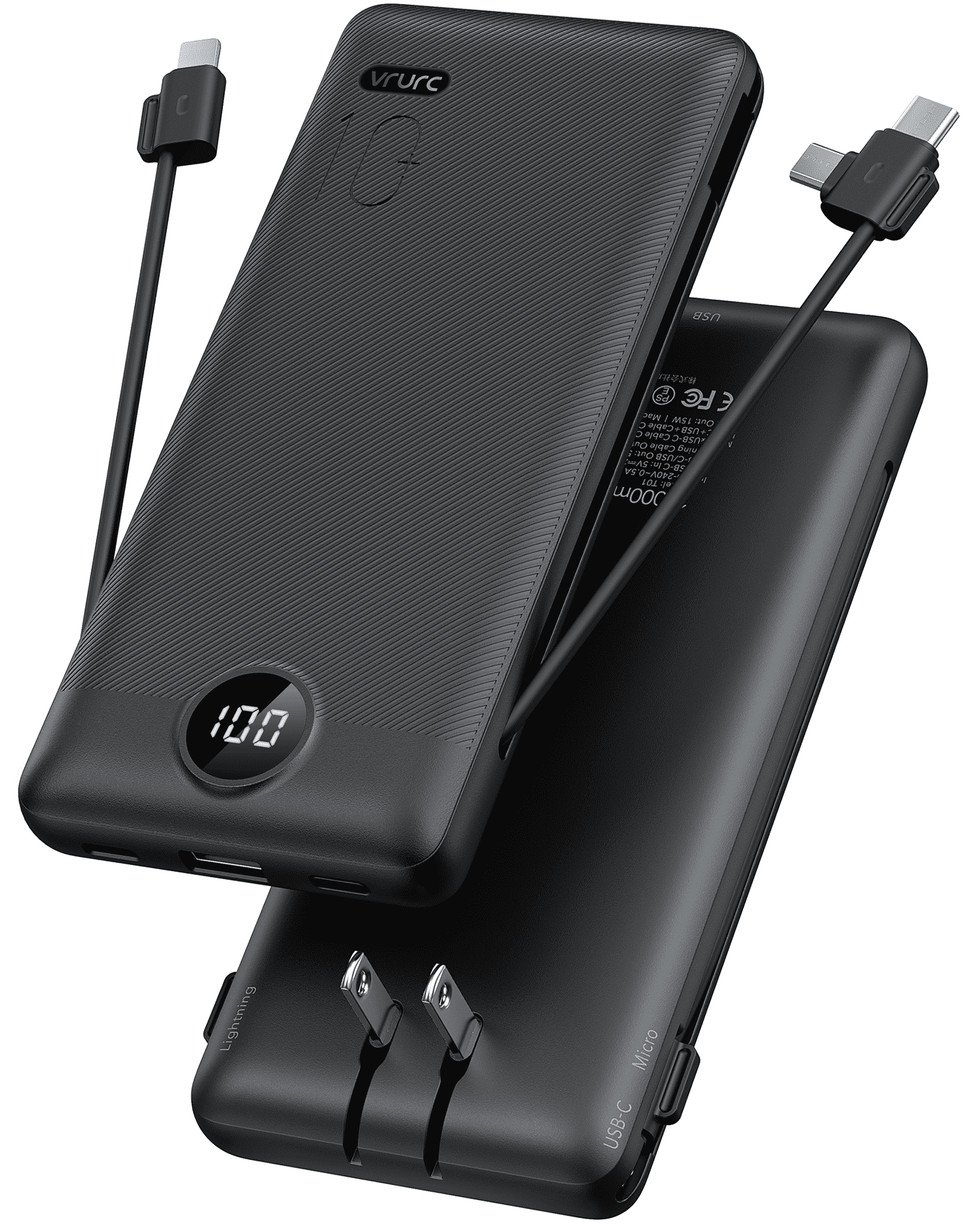
VRURC 10,000mAh Power Bank Built-in Cables and AC Wall Plug
10,000mAh | Built-in Cables | AC Wall Plug | Digital Display
View Current Price
View Product
VRURC 20,000mAh 22.5W Built-in Cables & AC Plug Power Bank
20,000mAh | Built-in Cables | AC Wall Plug | Digital Display
View Current Price
Learn MoreBuilt-in cables can mean fewer loose items to pack, provided the connectors match your devices. A built-in wall plug also simplifies refilling, but USB-C input may be quicker. The 20,000mAh product’s advertised 22.5W maximum applies to a compatible USB-A charging mode; it is not a guaranteed rate for every cable or phone. Check each connection’s rating and the shared-output limit before connecting several devices.
FAQ
Does a 20,000mAh Power Bank Charge Faster Than a 10,000mAh Model?
Not necessarily. Capacity alone does not determine phone charging speed. Phone charging speed depends on the output connection, compatible charging protocols, cable, and what the phone accepts. A 10,000mAh bank with a compatible higher-power output can charge a phone faster than a lower-output 20,000mAh bank. Multiple connected devices may also share the available power.
Is a 10,000mAh Power Bank Enough for Travel?
Often, yes, for moderate use of one phone with reliable daily recharging. A hotel stay with an outlet every evening can call for less portable reserve than one long day spent navigating and filming. Choose 20,000mAh if you need repeated charges or shared backup. If flying, read our guide, Can You Bring a Power Bank on a Plane? and your airline's current rules before packing.
How Long Will a 20,000mAh Power Bank Last?
It depends on how much energy you use each day. In the illustrative 77Wh-bank and 5,000mAh-phone calculation above, 2.8–3.2 full-charge equivalents represent approximately 280–320% of that phone battery’s rated energy. As a rough guide, that is enough for two complete refills plus most or all of a third; the lower end does not provide three complete refills. That might cover several days of light backup, but fewer days of heavy use. These are planning estimates; leave a reserve rather than relying on the upper end.
Conclusion
Choose enough reserve for your expected use, with a carrying weight that suits your routine. A 10,000mAh bank makes sense for regular phone top-ups; 20,000mAh is easier to justify for repeated charging, sharing, and uncertain access to power. Two smaller banks are worth considering when flexibility matters more than managing a single device.
Before choosing, check the weight, the cable you will use, and how you will refill the bank. Compare the VRURC 10,000mAh option with the VRURC 20,000mAh option, then choose the capacity that meets your charging needs.


